

The Peterloo Massacre, also known as the Manchester Massacre, was a tragic event of the early 19th century. What began as a peaceful demonstration advocating for democratic reforms and addressing widespread poverty turned into a bloody confrontation when government forces intervened. The event resulted in 18 deaths and left up to 700 individuals injured. Protesters had sought to improve their working and living conditions, demanding political reform, but their voices were met with violence instead of understanding. Next on manchesteryes.com.
Economic and Political Background of Early 19th-Century Manchester
The Napoleonic Wars ended in 1815, followed by a sharp economic downturn. These abrupt economic changes led to rising unemployment, recurrent crop failures exacerbated by the “Corn Laws” (which imposed high bread prices), and a host of other issues. At the time, only 11% of men in the UK had the right to vote, further worsening the unstable economic situation. Industrial regions like Manchester suffered the most under these circumstances.
In response, activists began advocating for parliamentary reform as a solution to these problems. Petitions demanding voting rights for men were repeatedly submitted to Parliament but were continually rejected. By 1819, with the economy in decline once again, tensions reached a boiling point.
What Triggered the Peterloo Massacre?

The Peterloo Massacre occurred on August 16, 1819, on St. Peter’s Field in Manchester. However, the bloody events were preceded by a series of underlying causes.
Understanding the massacre requires acknowledging the widespread discontent among Manchester’s working class. As the industrial hub of England, Manchester was central to the country’s development. However, the workers who powered its factories and mills were treated poorly. They lacked political representation, worked in harsh and unsanitary conditions, and were paid meagre wages. Class divisions deepened with each passing year, as the upper classes dismissed the working poor as insignificant.
This escalating dissatisfaction among Manchester’s labour force eventually led to calls for justice and democracy. Workers sought parliamentary representation, improved working conditions, and expanded rights. The initial calls for reform grew into a broader movement, with peaceful demonstrations gaining popularity. The working class wanted their voices to be heard by those in power.
Despite repeated attempts at peaceful protests and demands for parliamentary reform, both the Manchester and national governments ignored the demonstrators. This disregard culminated in the Peterloo Massacre and its tragic toll.
Timeline of the Peterloo Massacre
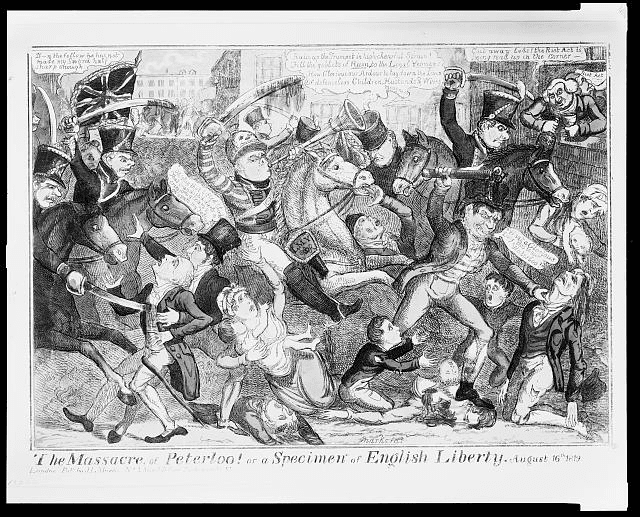
The events of the Peterloo Massacre unfolded on August 16, 1819. On that day, demonstrators, primarily working-class individuals, gathered at St. Peter’s Field in Manchester to hear speakers advocating for political and social parliamentary reforms.
The crowd numbered approximately 60,000, including men, women, and children. They came together with hopes of building a brighter future.
However, the authorities were not only unresponsive to their demands but also fearful of the demonstrations. In an attempt to preempt civil unrest, Manchester’s magistrates ordered the arrest of one of the speakers. To control the crowd of 60,000, they dispatched cavalry and infantry from the Manchester Yeomanry. Such drastic measures, including the prohibition of peaceful demonstrations, further inflamed tensions among the protesters.
When Manchester’s magistrates attempted to arrest the speaker, the peaceful gathering descended into chaos. The local cavalry charged into the crowd wielding sabres, violently dispersing the demonstrators. What began as a peaceful protest turned into a brutal confrontation between civilians and authorities.
The violent intervention resulted in over 700 injuries and 18 deaths. The bloodshed permanently stained the government’s reputation.
Did the Protesters Achieve Reform? The Aftermath of the Peterloo Massacre
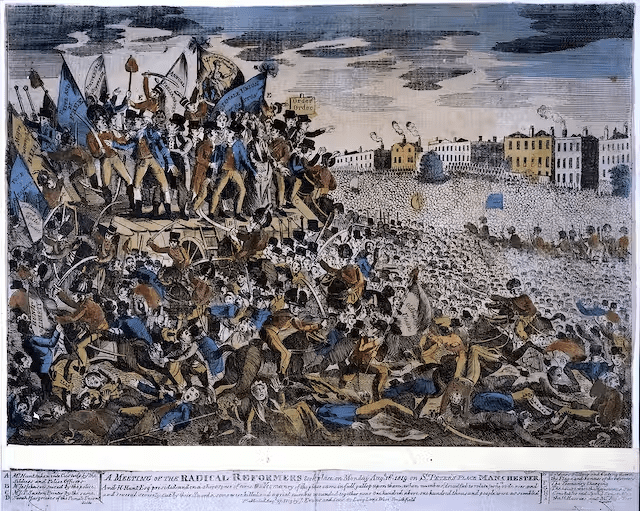
The Peterloo Massacre of 1819 is remembered as one of the bloodiest events of its era in British history. It serves as a grim reminder of how authorities should not respond to civil dissent.
The events of 1819 led to increased scrutiny of the government. However, achieving meaningful reforms proved to be a long and arduous process for the working class. By the late 19th century, parliamentary reforms were finally introduced, expanding voting rights and increasing parliamentary representation.
While the Peterloo Massacre did not result in immediate change, it laid the foundation for future reform movements. The tragedy became a rallying cry for those fighting for democracy, equality, and justice, highlighting the resilience and determination of Manchester’s working class.