

At the beginning of the 2000s, the attention of the whole world was focused on the approaching conflict in Iraq. In particular, the United States of America, being supported by the United Kingdom and other allies, was going to send its troops to this country. A military invasion was inevitable and the development of the military intervention caused widespread opposition in the world. Millions of people in different cities and countries went to rallies and protests to express their disagreement with the government’s decision. One of the UK largest protests against the Iraq War took place in the industrial city of Manchester in 2003. Learn more at manchesteryes.com.
Prerequisites of the Iraq War

One of the main justifications for the US and UK invasion of Iraq in the early 2000s was the belief that Iraq possessed weapons of mass destruction. That is, the superpowers tried to prevent an attempt to use chemical or biological weapons. However, as it turned out after the invasion, no evidence was found that would confirm the presence of dangerous weapons on the territory of Iraq.
In addition, the White House, led by Bush at the time, claimed that Saddam Hussein’s regime had ties to terrorist organisations such as Al-Qaeda. The situation became especially acute after the terrorist attacks of September 11 in New York. However, this reason for the invasion also lacks any solid evidence.
Another reason for the foreign invasion of Iraq was the superpowers’ desire to overthrow Saddam Hussein. The USA, Great Britain and other countries believed that his political regime was a threat to the stability of the entire region. Its elimination would contribute to the establishment of political stability. In addition, the invasion of Iraq was also motivated by such existential problems as the violation of human rights and the policy of brutality of the ruling class. First of all, the USA and Great Britain wanted to save the innocent citizens of Iraq, who were deprived of their rights and freedoms.
The decision to start the war was highly controversial. Opponents around the world have argued that there was no evidence of weapons of mass destruction in Iraq. In addition, an invasion could lead to regional destabilisation, mass casualties and a protracted conflict. Despite the massive protests that swept across the world in the early 2000s and all of the above-mentioned fears, the invasion of Iraq took place in 2003, leading to a protracted conflict with enormous consequences.
Manchester residents against the Iraq War
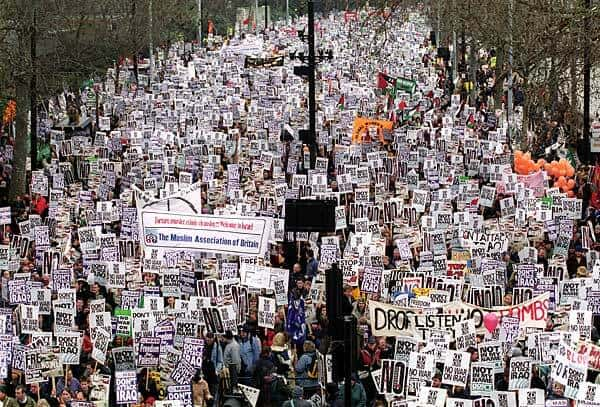
The people of Manchester have always been very active in public life. They have always been interested in the well-being of the city and other countries. Having learned about the intentions of the US and British governments to invade Iraq, they didn’t remain silent. Youth, workers, politicians, lawyers and other residents of the city began to organise regular peaceful protests against the Iraq War. By all means, they wanted to be heard by the top British and American authorities and wanted to prevent all the terrible consequences of the invasion.
What was the largest protest in Manchester?
The largest protest in Manchester began in September 2003. It was held before the traditional annual meeting of the ruling Labour Party. More than 30,000 people came to the rally in Manchester to attract attention. In particular, they opposed the presence of British troops in Iraq.
All the demonstrators gathered in Albert Square. Then they marched around the conference centre, where the delegates of the Labour Party were to sit. The families of those who died in Iraq set up a “Peace Camp” of six tents near the city hotel where the party leaders stayed. In such a way, they hoped to attract the attention of the Prime Minister of Great Britain, Tony Blair.
Demonstrators who gathered outside the conference venue accused the then British Prime Minister of supporting the US in an illegal war in Iraq and of failing to condemn the fighting that took place between Israeli forces and Hezbollah guerrillas in south Lebanon.
Journalists George Galloway and Lauren Booth as well as the sister of Prime Minister’s wife Cherie, who criticised Blair for his position and actions, spoke in front of the protesters. At the same time, British Prime Minister Blair claimed to protesters in Manchester that the conference of the Labour Party would be his last and promised to retire in 2003.
That protest was one of the largest in Great Britain. In addition, it served as a powerful impetus for the British authorities and allied countries to think about their foreign policies and military actions. Activists have been calling for an end to the war and an end of the conscription. Manchester families shouldn’t suffer losses due to the Iraq War.
Although protesters in Manchester failed to stop the invasion and the war, the protests became a symbol of the city’s solidarity. Nevertheless, the anti-war protests in Manchester in 2003 became an integral part of its history and the struggle for justice and peace.